Leave Your Message
Choosing China’s top White Light Bulbs manufacturers requires more than comparing prices or counting product models. A reliable decision begins with the intended space, lighting hours, color temperature, and expected service life. A workshop may need strong, cool illumination. A bedroom may require softer white light. The difference can be felt on a workbench, where shadows reveal poor beam control.
Dr. Mariana Figueiro, a respected lighting researcher, has said, “Light is the most powerful synchronizer of the human circadian system.” Her observation reminds buyers that brightness is not the only concern. White Light Bulbs should also provide stable color quality, low flicker, suitable heat management, and consistent performance. Check the claimed lumens, color rendering index, beam angle, warranty terms, and independent test reports. Packaging alone proves very little.
A dependable Chinese manufacturer should explain its LED chips, driver design, aging tests, and quality-control process. Ask for samples before placing a large order. Test them in the real installation, not only in a showroom. Compare light output after several hours of operation. Small details matter.
The process is not perfectly simple. A high CRI rating may increase cost, while a low-cost bulb may appear attractive but perform unevenly. Some specifications also look impressive without enough testing evidence. That uncertainty deserves attention. Buyers should review factory experience, certifications, export history, and after-sales support together. The best supplier is not always the largest one. It is the manufacturer that offers clear evidence, consistent products, and practical answers.
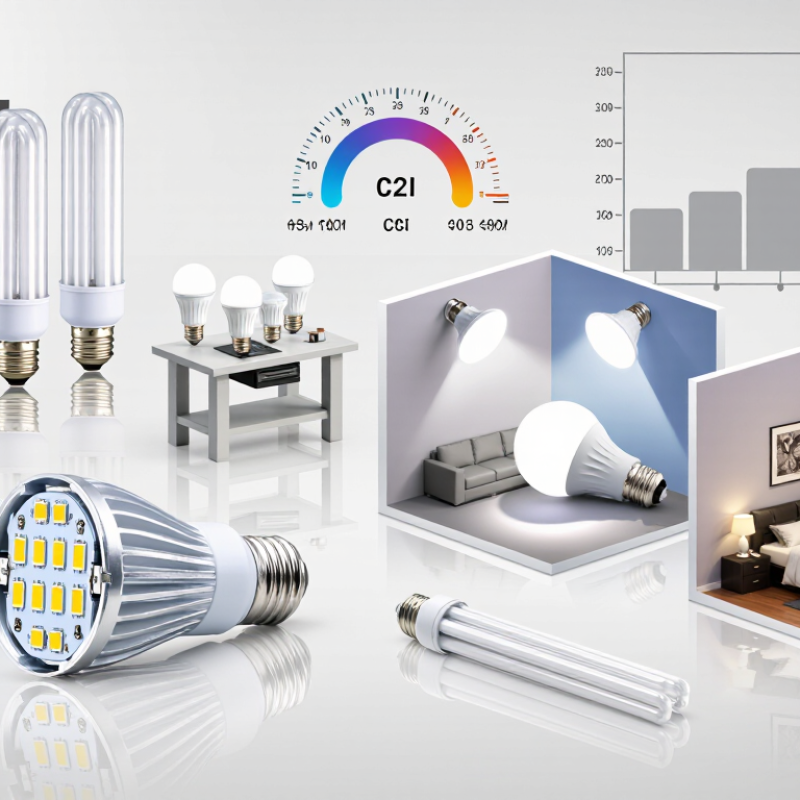
A high-quality white light bulb manufacturer in China proves performance before discussing price. Check test reports for luminous flux, power factor, color rendering, and lifetime. The U.S. Department of Energy states that quality LED products can last about 25,000 to 50,000 hours. However, real performance depends on heat control, driver design, and operating conditions. A bright sample means little without stable testing.
Color consistency also matters. For retail, offices, and hospitality projects, ask for a measured CCT range, CRI data, and tolerance details. The International Energy Agency reports that LED technology now represents a major share of global lighting sales, making quality control increasingly important. Request reports from accredited laboratories, not only factory-produced spreadsheets. Verify standards such as IEC safety requirements and suitable photobiological risk testing. Small details matter, such as solder quality, insulation spacing, and thermal paste coverage.
Tips: Request three samples from different production batches. Test them for flicker, heat, and light stability after several hours. Ask how failed units are recorded and corrected. A reliable supplier should explain the process clearly. Do not accept vague claims like “premium chip” without measurable evidence. Factory audits can reveal clean assembly areas, calibrated instruments, and traceable materials. Still, no supplier is perfect. Even experienced buyers can overlook packaging damage or voltage differences. That is why independent inspection remains valuable before large orders.
| Evaluation Dimension | Recommended Benchmark | What to Verify | Why It Matters | Priority |
|---|---|---|---|---|
| Product Safety Compliance | Applicable national and destination-market safety requirements | Valid test reports, declarations of conformity, electrical safety records, and factory quality procedures | Reduces electrical, thermal, and regulatory risks during import and use | Critical |
| Color Temperature Range | Common white-light options: 2700–3000 K warm white, 4000 K neutral white, 5000–6500 K daylight | Measured CCT data and production consistency between batches | Ensures the light appearance matches residential, retail, office, or industrial applications | High |
| Color Rendering Index | CRI (Ra) ≥80 for general lighting; CRI ≥90 for retail, hospitality, photography, and high-color-accuracy applications | Test results for Ra and, where relevant, R9 or other extended color-rendering values | Higher color rendering makes objects appear more natural and accurate | High |
| Luminous Efficacy | Compare lumens per watt for the same lamp shape, power rating, and operating conditions | Integrating-sphere reports showing input power, luminous flux, and test temperature | Higher efficacy can deliver the required brightness with lower energy consumption | High |
| Rated Lifetime | A clearly defined LED lifetime, commonly based on an L70 maintenance target and specified operating conditions | Lifetime calculation method, temperature assumptions, component quality, and warranty terms | Prevents misleading lifetime claims and helps estimate replacement costs | High |
| Flicker Performance | Low-flicker or flicker-free design for offices, schools, cameras, and other sensitive environments | Flicker percentage, flicker index, or PstLM and SVM results measured under applicable methods | Reduces visible modulation and potential camera-band or visual-comfort problems | High |
| Power Factor | Prefer PF ≥0.90 for commercial or larger installations; confirm the target-market requirement | Power-factor and total-harmonic-distortion data at rated voltage | Improves electrical efficiency and helps manage installation-level power quality | Medium |
| Thermal Management | Adequate heat dissipation for the intended enclosure, ambient temperature, and duty cycle | Housing material, thermal test data, driver temperature, and performance in enclosed fixtures | Excessive heat accelerates lumen depreciation and shortens electronic-component life | Critical |
| Driver and Component Quality | Stable current regulation, suitable capacitors, surge protection, and consistent LED-bin selection | Bill of materials, incoming inspection records, aging tests, and driver reliability data | The driver is a major factor in startup reliability, flicker, lifetime, and warranty claims | Critical |
| Quality-Control System | Documented incoming, in-process, aging, and final inspection procedures | Inspection plans, calibration records, defect-rate data, traceability, and corrective-action reports | Demonstrates that quality is controlled systematically rather than by final sampling alone | Critical |
| Customization Capability | Support for socket types, wattages, CCT, CRI, dimming, packaging, and regional requirements | Engineering samples, tooling capability, minimum order quantity, and change-control process | Helps buyers obtain application-specific products without sacrificing consistency | Medium |
| Production Capacity | Capacity should match forecast demand while maintaining stable lead times and inspection standards | Monthly capacity, production schedule, equipment list, staffing, and peak-season contingency planning | Reduces supply interruptions and unexpected changes in product quality | High |
| Sample and Batch Consistency | Brightness, CCT, CRI, power, and dimensions should remain within agreed specifications | Independent sample testing, batch comparison, tolerance limits, and retained samples | Ensures the delivered goods match approved samples and purchase specifications | Critical |
| Warranty and After-Sales Support | Written warranty covering duration, exclusions, claim evidence, replacement, and response time | Warranty policy, service contact, failure-analysis process, and historical claim handling | Provides measurable protection against premature failures and service disputes | High |
| Packaging and Traceability | Protective packaging with model, lot, electrical rating, date, and inspection information | Packaging tests, carton labeling, barcode or lot system, and shipment inspection records | Lowers transit damage and makes quality issues easier to isolate and resolve | Medium |